

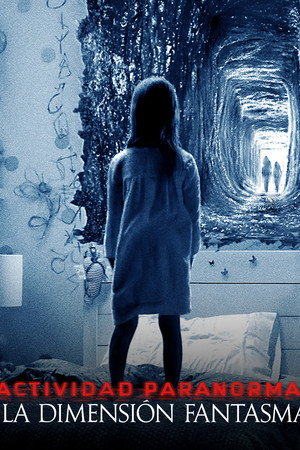
Actividad Paranormal 6: La dimensión fantasma (2015)
Resumen
Cuando una familia nueva se muda a la antigua casa de Katie y Kristi, descubrirán una misteriosa cámara de video que revela la presencia de un viejo demonio que comienza a aterrorizarlos. Ahora, con el alma de la hija más pequeña en peligro, deberán luchar contra esta amenaza demoníaca antes de convertirse en sus próximas víctimas. Este es el capítulo más reciente de esta revolucionaria serie de películas de horror.
El argumento podría seguir la línea narrativa de sus predecesoras, en las que los distintos protagonistas son atormentados por extraños sucesos paranormales, que son captados y estudiados a través de cámaras que colocan en su propia casa. En esta secuela, nuevas situaciones y personajes tendrán que enfrentarse a las escalofriantes apariciones, ¿conseguirán salir ilesos de estos terribles sucesos?
Using a special camera that can see spirits, a family must protect their daughter from an evil entity with a sinister plan.
Actores Principales

Chris J. Murray
Ryan

Brit Shaw
Emily

Ivy George
Leila

Dan Gill
Mike

Olivia Taylor Dudley
Skyler

Chloe Csengery
Katie

Jessica Tyler Brown
Kristi

Don McManus
Kent

Michael Krawic
Father Todd

Hallie Foote
Grandma Lois
Tráiler

Reseñas
Una reseña de Marco-Hugo Landeta Vacas
(CASTELLANO) Una saga construida alrededor de aquello que apenas vemos corre un riesgo enorme cuando decide que ha llegado el momento de enseñarlo. Paranormal Activity: Dimensión fantasma comete precisamente ese error. Después de varias entregas basadas en ruidos, puertas que se mueven, sombras, objetos desplazados y largos planos donde uno buscaba desesperadamente cualquier cambio, aquí lo sobrenatural empieza a adquirir una presencia mucho más concreta. Y cuanto más visible se vuelve, menos miedo produce. Las primeras películas entendían algo elemental del terror: esperar puede ser mucho más inquietante que mirar. Una habitación aparentemente vacía podía generar más tensión que cualquier criatura digital porque el espectador empezaba a fabricar su propio miedo. El ojo recorría cada esquina del encuadre, buscando algo que quizá ni siquiera estuviera allí. Esa participación era parte fundamental de la experiencia. Aquí, en cambio, la película parece desconfiar de esa paciencia. Introduce recursos destinados a hacer perceptible aquello que antes permanecía oculto y convierte el misterio en una forma visual identificable. Técnicamente puede parecer una evolución lógica para una sexta entrega, pero dramáticamente resulta casi lo contrario: transforma lo inexplicable en algo demasiado concreto. Ese cambio afecta directamente al miedo. Mientras otras entregas de la saga conseguían ponerme bastante nervioso con recursos mínimos, esta me dejó prácticamente frío. No porque ocurran menos cosas, sino porque están planteadas de una manera mucho menos eficaz. Hay más voluntad de enseñar, más efectos y más actividad visual, pero menos sensación de amenaza. La cámara había sido siempre una herramienta fundamental de la franquicia. No era solo una excusa de found footage, sino una forma de limitar nuestra información. Veíamos exactamente lo mismo que los personajes y, muchas veces, ni siquiera sabíamos dónde mirar. Esa incertidumbre convertía cada plano fijo en una prueba de atención. Dimensión fantasma modifica esa relación y utiliza la tecnología para ampliar lo que podemos ver. El resultado paradójico es que cuanto más información recibimos, menos imaginación necesitamos. También se nota el cansancio de la fórmula. Los mecanismos de la saga son ya demasiado reconocibles: la casa, la grabación constante, los ruidos nocturnos, la escalada progresiva y la expectativa del sobresalto. Repetirlos no sería necesariamente un problema si todavía funcionaran, pero aquí se sienten mucho más mecánicos. Uno empieza a percibir la construcción de la escena antes de sentir miedo dentro de ella. La película intenta compensarlo ampliando la mitología y dando más importancia a conexiones acumuladas a lo largo de la franquicia. Para quien haya seguido todas las entregas puede tener cierto interés ver cómo encajan determinadas piezas, pero esa preocupación por cerrar y explicar termina perjudicando otra vez al terror. En este género, comprender demasiado rara vez ayuda. El problema no está únicamente en los efectos visuales, sino en la filosofía que representan. Cuando lo sobrenatural era una fuerza invisible, parecía capaz de estar en cualquier sitio. Cuando adquiere una forma demasiado definida, se convierte en algo que podemos observar, medir e incluso anticipar. El misterio deja de ocupar toda la habitación y queda reducido a aquello que la cámara decide mostrarnos. Tampoco los personajes consiguen compensar esa pérdida. Cumplen su función dentro del mecanismo, pero cuesta implicarse emocionalmente con ellos. La película está más preocupada por mover las piezas de la mitología y preparar el siguiente fenómeno que por construir unas relaciones especialmente memorables. Hay algún momento visualmente curioso y la idea de utilizar una tecnología específica para percibir lo invisible tiene posibilidades. Pero esa misma idea contiene el gran error de la película: Paranormal Activity funcionaba mejor cuando no necesitábamos ver. Por eso esta entrega me parece una de las más flojas de la saga. No porque sea más tranquila que las anteriores, sino porque ha olvidado por qué funcionaban sus silencios. Antes una puerta entreabierta podía hacerme mirar la pantalla con tensión. Aquí pueden ocurrir cosas mucho más evidentes y, sin embargo, el miedo apenas aparece. Paranormal Activity: Dimensión fantasma enseña más, explica más y visualiza más, pero asusta bastante menos. Y cuando una película de terror perteneciente a una saga que ya había demostrado que podía inquietarme termina dejándome indiferente, el problema no es que yo conozca demasiado el truco: es que el truco ha dejado de funcionar. (ENGLISH) A franchise built around what we can barely see takes a huge risk when it decides that the time has come to show it. Paranormal Activity: The Ghost Dimension makes exactly that mistake. After several films based on noises, moving doors, shadows, displaced objects and long static shots where we desperately searched for a change, the supernatural presence becomes much more concrete here. And the more visible it becomes, the less frightening it feels. The earlier films understood something fundamental about horror: waiting can be far more disturbing than looking. An apparently empty room could create more tension than any digital creature because the viewer began constructing the fear. Your eyes searched every corner of the frame for something that might not even be there. That participation was essential to the experience. This film, however, seems to distrust that patience. It introduces devices designed to make the previously invisible perceptible and turns mystery into an identifiable visual form. Technically, that may look like a logical evolution for a later sequel, but dramatically it has almost the opposite effect: the unexplained becomes too concrete. That change directly affects the fear. While other entries in the series genuinely made me uneasy with very simple tools, this one left me almost completely cold. Not because fewer things happen, but because they are staged far less effectively. There is more determination to show, more effects and more visual activity, yet less sense of threat. The camera had always been a fundamental tool in the franchise. It was not merely an excuse for found footage, but a way of restricting information. We saw exactly what the characters saw and often did not even know where to look. That uncertainty turned every fixed shot into a test of attention. The Ghost Dimension changes that relationship and uses technology to expand what we can perceive. The paradox is that the more information we receive, the less imagination we need. The fatigue of the formula is also obvious. The series' mechanisms have become too familiar: the house, constant recording, nighttime noises, progressive escalation and the expectation of a sudden scare. Repeating them would not necessarily be a problem if they still worked, but here they feel far more mechanical. You begin noticing the construction of the scene before feeling any fear within it. The film tries to compensate by expanding the mythology and giving more importance to connections accumulated throughout the franchise. For viewers who have followed every installment, there may be some interest in seeing pieces fit together, but that desire to explain and close things down again damages the horror. In this genre, understanding too much rarely helps. The problem is not simply the visual effects but the philosophy behind them. When the supernatural was an invisible force, it seemed capable of being anywhere. Once it acquires a defined form, it becomes something we can observe, measure and even anticipate. The mystery stops filling the entire room and becomes limited to whatever the camera chooses to show us. The characters do not compensate for that loss either. They serve their function within the mechanism, but it is difficult to become emotionally invested in them. The film is more concerned with moving pieces of mythology and preparing the next phenomenon than with building memorable relationships. There are a few visually interesting moments, and the idea of using a specific technology to perceive the invisible has potential. But that same idea contains the film's central mistake: Paranormal Activity was more effective when we did not need to see. That is why this feels like one of the weakest entries in the series. Not because it is quieter than the earlier films, but because it has forgotten why their silences worked. A half-open door once could make me stare at the screen with genuine tension. Here, far more obvious things can happen and yet the fear barely appears. Paranormal Activity: The Ghost Dimension shows more, explains more and visualizes more, but scares far less. And when a horror film belonging to a franchise that had already proven capable of unsettling me ends up leaving me indifferent, the problem is not simply that I know the trick too well. The trick itself has stopped working.