

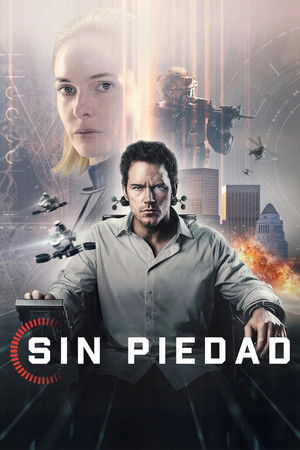
Sin piedad (2026)
Resumen
En un futuro cercano, un detective es juzgado por el asesinato de su esposa. Tiene noventa minutos para demostrar su inocencia ante el Juez de Inteligencia Artificial que una vez defendió, antes de que este determine su destino.
En un futuro próximo, un detective (Chris Pratt) es acusado de asesinar a su esposa. Tiene 90 minutos para demostrar su inocencia ante la Jueza de la I.A. avanzada (Rebecca Ferguson), a la que él mismo defendió en su día, antes de que esta decida su destino.
In the near future, a detective stands on trial accused of murdering his wife. He has ninety minutes to prove his innocence to the advanced AI Judge he once championed, before it determines his fate.
Actores Principales

Chris Pratt
Chris Raven

Rebecca Ferguson
Judge Maddox

Kali Reis
Jacqueline 'Jaq' Diallo

Kylie Rogers
Britt Raven

Chris Sullivan
Rob Nelson

Jeff Pierre
Patrick Burke

Annabelle Wallis
Nicole Raven

Rafi Gavron
Holt Charles

Kenneth Choi
Ray Vale

Jamie McBride
Dan Vogel
Tráiler
Reseñas
Una reseña de Marco-Hugo Landeta Vacas
(CASTELLANO) La idea de partida es más interesante que la primera impresión que produce la película. Al principio, tanta pantalla, porcentajes, datos y lenguaje tecnológico me resultó algo pesado. Todo parece demasiado mecánico y frío, como si la película estuviera más interesada en enseñarnos su dispositivo que en conseguir que entremos en la historia. Pero poco a poco empieza a funcionar mejor. Timur Bekmambetov construye el thriller alrededor de una pregunta bastante inquietante: ¿qué ocurre cuando confiamos tanto en los datos que empezamos a tratarlos como si fueran sinónimo de verdad? El sistema puede acceder a cámaras, mensajes, redes, localizaciones y prácticamente cualquier rastro digital. Sobre el papel parece una forma perfecta de eliminar errores humanos. El problema es que los datos también necesitan interpretación, y ahí aparece la parte más interesante de Sin piedad. Chris Pratt sostiene buena parte de la película prácticamente atrapado dentro de ese mecanismo. No me parece uno de sus mejores trabajos, pero transmite bastante bien la sensación de estar luchando contra algo que parece conocerlo todo sobre él. Rebecca Ferguson funciona precisamente en el extremo contrario: fría, medida y casi completamente deshumanizada. Esa distancia encaja con el personaje y refuerza la sensación de que no estás discutiendo con una persona, sino intentando convencer a un sistema. La película mejora cuando deja de explicar tanto su mundo y empieza a jugar de verdad con la investigación. Entonces aparece el thriller: contradicciones, detalles que adquieren otro significado y una carrera contra el tiempo que por fin genera tensión. Ahí fue cuando empezó a interesarme bastante más. El mecanismo tecnológico deja de ser decoración y se convierte en una herramienta narrativa. No creo, sin embargo, que la película exprima del todo las posibilidades de su propia premisa. Había material para una reflexión mucho más inquietante sobre vigilancia, privacidad, presunción de inocencia y delegación de decisiones judiciales en una inteligencia artificial. Bekmambetov toca todas esas ideas, pero casi siempre prefiere mantener el ritmo antes que profundizar demasiado. Como reflexión sobre la IA se queda algo corta; como thriller funciona bastante mejor. También tiene ese problema típico de algunas películas que empiezan con una idea relativamente contenida y después sienten la necesidad de aumentar continuamente el espectáculo. Cuanto más intenta convertirse en una gran película de acción, menos interesante me resulta que cuando simplemente coloca a una persona frente a una máquina que pretende conocer la verdad mejor que ella misma. Aun así, terminé bastante mejor de lo que había empezado. El inicio se me hizo pesado y demasiado pendiente de su propio artificio, pero según fui entrando en la investigación me enganchó. No es una gran distopía ni una reflexión especialmente profunda sobre la inteligencia artificial, pero tiene una premisa atractiva, consigue generar tensión y acaba funcionando como entretenimiento. Una película irregular que mejora claramente a medida que avanza. (ENGLISH) The basic idea is more interesting than the film's first impression suggests. At first, all the screens, percentages, data and technological language felt somewhat heavy to me. Everything seems too mechanical and cold, as if the film were more interested in showing off its device than in drawing us into the story. But gradually it begins to work much better. Timur Bekmambetov builds the thriller around a genuinely unsettling question: what happens when we trust data so completely that we begin treating it as synonymous with truth? The system can access cameras, messages, social media, locations and almost every digital trace imaginable. On paper, that sounds like a perfect way to eliminate human error. The problem is that data still requires interpretation, and that is where Mercy becomes most interesting. Chris Pratt carries much of the film while effectively trapped inside that mechanism. I would not call it one of his strongest performances, but he conveys the feeling of fighting against something that appears to know everything about him. Rebecca Ferguson works at the opposite extreme: cold, measured and almost entirely dehumanized. That distance suits the character and reinforces the sense that you are not arguing with a person, but trying to persuade a system. The film improves once it stops explaining its world so much and starts genuinely playing with the investigation. That is when the thriller emerges: contradictions, details taking on different meanings and a race against time that finally generates tension. That was when I became much more engaged. The technological device stops being decoration and becomes a narrative tool. I do not think, however, that the film fully explores the possibilities of its own premise. There was room for a much more disturbing reflection on surveillance, privacy, the presumption of innocence and the delegation of judicial decisions to artificial intelligence. Bekmambetov touches on all of those ideas, but usually chooses momentum over depth. As a meditation on AI, it falls somewhat short; as a thriller, it works considerably better. It also suffers from the familiar problem of films that begin with a relatively contained idea and then feel compelled to keep increasing the spectacle. The more it tries to become a large-scale action movie, the less interesting it is to me than when it simply places a human being in front of a machine that claims to understand the truth better than they do. Even so, I ended up feeling much more positive than I did at the beginning. The opening felt heavy and overly concerned with its own gimmick, but once I became involved in the investigation, it drew me in. It is neither a great dystopia nor an especially deep reflection on artificial intelligence, but it has an appealing premise, generates tension and ultimately works as entertainment. An uneven film that clearly improves as it goes along.